



INDL South Asia Workshop
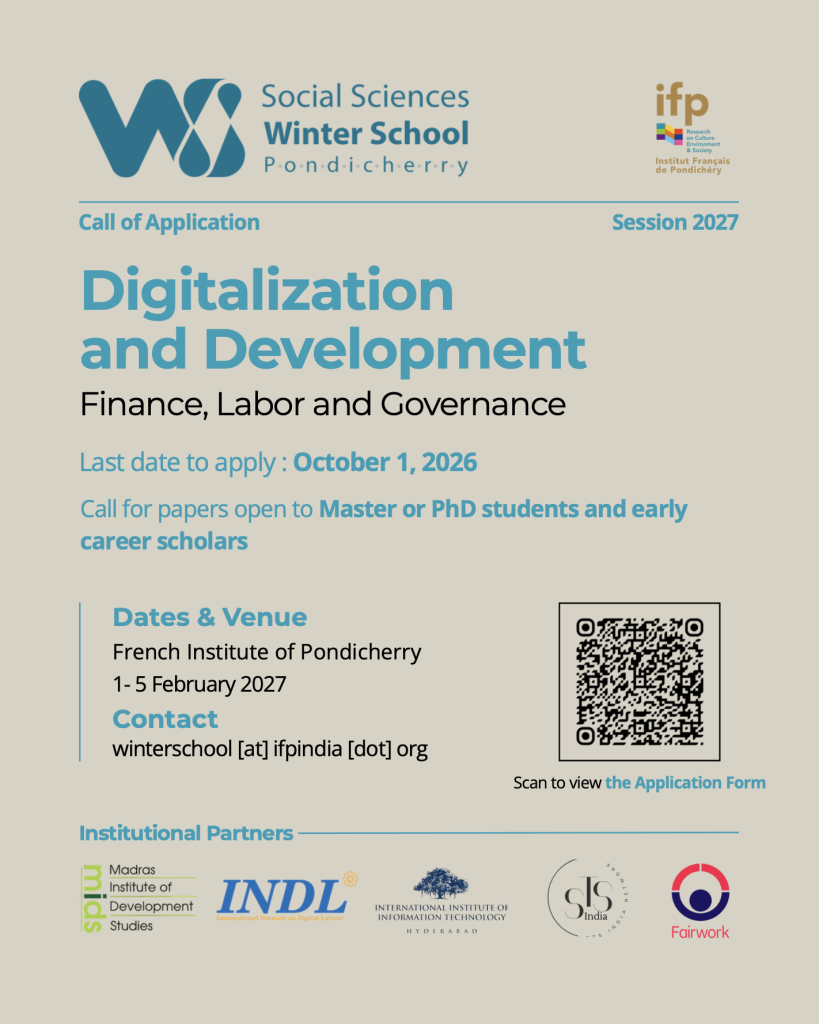
Social Sciences Winter School Pondicherry, 1-5 February 2027
French Institute of Pondicherry, India
INDL South Asia Workshop on Digital Labour 2027
Social Sciences Winter School Pondicherry
1-5 February 2027, French Institute of Pondicherry
The International Network on Digital Labour is organizing its first workshop in South Asia on Digital Labour as a part of the Social Sciences Winter School Pondicherry, to be held at the French Institute of Pondicherry between 1-5 February 2027.
The purpose of the INDL workshop is to think of possible theorization in terms of upcoming scholarship on digital labour in the South Asian region by critically engaging with the empirical data . We aim to provide a space for constructive and detailed feedback to PhD scholars and early career scholars. The applicants are encouraged to submit research papers that are methodologically rigorous and theoretically innovative, and addresses issues of gender, caste, class, migration, regional disparity and so on, in the South Asian Context. Please check the call for papers for further details.
The workshop is co-organised by INDL as part of the Social Sciences Winter School Pondicherry and participants at the workshop will have the chance of attending winter school sessions, and vice versa.
The Social Sciences Winter School in Pondicherry (SSWSP) is organized by the French Institute of Pondicherry.
The institutional partners for SSWSP 2027 are Madras Institute of Development Studies, the International Network on Digital Labour, International Institute of Information Technology – Hyderabad, STS India Network, and Fairwork India.
Applications are now closed. Selected applicants will be notified via email.
SSWSP Website: https://winterspy.hypotheses.org/11525
Please email contact@indl.network for questions regarding the Digital Labour workshop. For questions relating to other working groups or the winter school itself, please email winterschool@ifp.org
Members of the organizing committee for the Digital Labour Working Group are Prof. Antonio Casilli (DiPLab, Institut Polytechnique de Paris), Prof. Balaji Parthasarathy (Fairwork India), Dr. Kanikka Sersia (University of Lausanne), and Aishik Saha (National and Kapodistrian University of Athens).
INDL South Asia Call for papers
Workshop on Digital Labour 2027 | Social Sciences Winter School Pondicherry
1-5 February 2027, French Institute of Pondicherry
Digital Labour as an analytical category emerged across a range of disciplines for insights into the growth of new groups of workers who have primarily responded to the transformation of the labour market through the internet (Scholz 2013). Others have argued for the broadening of the definition of digital labor to map the common features across unpaid user activity, platform-mediated gig work, and formal employment within the digital media industries (Jarrett 2022; Fuchs 2014). Many of the labour management models considered unique to Digital Labour have existed in their inchoate sense in South Asian labour markets.
Despite the ever-expanding size and scale of the platform economy, workers face precarity, informalization, and lack social security. Due to a lack of recognised channels of collective bargaining, workers are collectively resisting, and negotiating with the positions of power, policies and ideologies. Meanwhile, the regulatory framework is evolving, addressing the demands of platform workers. The growing startup culture and local platforms are also challenging the dominance of major platforms like Google, Amazon, and Uber, making South Asia an important site for research on digital labour. Platform apps like those for ride-hailing, food delivery, online shopping, and logistics, use algorithms to mediate work, also referred to as the ‘algorithmic management of work’ (ILO 2021; Wood et al 2019; Woodcock and Graham 2019). This also extends to data work which has deep historical roots in South Asia, particularly through companies operating in the Business Process Outsourcing (BPO) or Information Technology Enabled Services (ITES) sectors. The network of suppliers, platforms and human workers doing data work also increasingly contributed to what is understood as ‘AI value chains’ (Anwar 2025).
The INDL workshop will focus on the South Asian countries that have historically been a source of low-wage labour, to make the contemporary global digital economy possible in the first place. The purpose of the INDL workshop is to think of possible theorization by critically engaging with the empirical data. We also hope to encourage scholars to interrogate the existing notions of ‘digital labour’ beyond the dominant paradigms mentioned above.
Applicants are encouraged to submit research papers that are methodologically rigorous and theoretically innovative, and addresses issues of gender, caste, class, migration, regional disparity and so on, in the South Asian Context. The topics for submissions include but are not limited to,
- Digital labour, precarity, and gig work
- Data work, annotation, and AI supply chain
- Platforms and startup culture
- Creative labour and creator economies
- Alternative platform models such as cooperatives
- Regulating the platforms and policy discourse
We invite PhD candidates ideally in advanced stages of their research and early career scholars to submit an EXTENDED ABSTRACT of approximately 3000 words.
Application Procedure
Please use the following registration form. If you are interested in the Digital Labour Working Group (Working Group 3), please select the option “Working Group 3: Digital Labour” under “Which working group are you applying to for this Winter School?” while applying.
Important dates
- Deadline for Extended Abstracts: October 01, 2026
- Notification of Accepted Papers: October 15, 2026
- Confirmation from Attendees: October 30, 2026
- Apply for Visa Letter, if need: November 15, 2026
- Workshop Dates: February 1-5, 2026
INDL South Asia Program
INDL-NA Opening Keynote

Julia Ticona, Ph.D.
Julia Ticona is an assistant professor at the Annenberg School for Communication, where her research investigates the ways that digital technologies shape the meaning of precarious work. She uses qualitative methods to examine the role of tech in the construction of identity and inequality for low-wage workers. Previously, she was a postdoctoral scholar at the Data & Society Research Institute, where she collaborated on an amicus brief on behalf of Data & Society for Carpenter vs. U.S. before the U.S. Supreme Court. She is an Associate Fellow at the Institute for Advanced Studies in Culture. She received her Ph.D. in Sociology from the University of Virginia, where she was a member of the Society of Fellows, and her B.A. from Wellesley College. You can find her work in the Journal of Communication, New Media & Society, the International Journal of Communication, and Information, Communication, and Society. She has also published op-eds and essays in Wired, Dissent, FastCompany, and Slate. She has also been called on as an expert by local and national media outlets, including: The New York Times, NPR, The Nation, and The Philadelphia Inquirer.
INDL-SA Organizing Committee
Antonio Casilli DiPLab, Institut Polytechnique de Paris
Prof. Balaji Parthasarathy Fairwork India
Dr. Kanikka Sersia University of Lausanne
Aishik Saha National and Kapodistrian University of Athens


